Nobody noticed yet… but they will.
We just reached the end of an economic age.
Something that usually takes decades, even centuries, to play out just happened in what seems like a blink of an eye.
Unless you understand the magnitude of what just happened, you could risk losing everything you’ve worked so hard to achieve because this collapse is only just getting started.
You see, for our entire life, the story arc has been clean: it was the relentless rise, in both wealth and status, of a broad social class of professionals but that rainbow is now at an end.
Because for the first time ever, capital can now compound without additional labor.
The centuries-old relationship where job creation and GDP rose together has snapped and the economy can now scale without bringing workers along for the ride.
And this “snap” is about to change everything.
This is one of those moments in which I believe vast fortunes will be made and lost. I’m talking about a generational transfer of wealth… the type that can either enrich you or potentially impoverish you, based on the decisions you make.
Because history shows us that while these shifts always lead to catastrophic losses for those who refuse to prepare… they also unleash unprecedented wealth building potential for those who understand, and harness, the forces at work.
And this isn’t a prediction. It’s happening right now.
It’s why, although we’re seeing massive headline economic growth, the average American is being left behind.
AI Engels’ Pause
They don’t teach you this in school, but they should.
During the Industrial Revolution, Friedrich Engels noticed that although the revolution was making Britain incredibly rich when measured via GDP… the vast majority of British people were living in hell.
Between 1790 and 1840 Britain’s GDP exploded. The steam engine created massive efficiency gains, corporate profits doubled, and the stock market soared.
But for the average worker, real wages remained flat or fell… the average life expectancy in some industrial cities collapsed to just 35 years…
It was as though someone had pressed a giant “Pause” button on quality of life for the working class.
Of course, the wealth did eventually trickle down but it was half a century later and during that half century, the societal devastation was dire. It took two full generations for the labor market to adjust.
And the weavers who lost their jobs to power looms, they didn't become "machine repairmen."
They starved. They rioted. They were shot by the military or shipped to penal colonies. And it was Engels’ Pause that gave birth to Marxism.
And we’re seeing this again with AI.
The only difference is, this time it won’t take decades to play out. It took the radio 38 years to reach 50 million users. Television took 13. The internet took 4. But ChatGPT hit 100 million users in two months.
We are effectively speed-running the 19th century. We’re compressing 50 years of displacement into less than a decade… and this time the disruption isn’t coming for the illiterate farmhand…
It’s coming for the accountant. It’s coming for the lawyer. It’s coming for you and me.
Right now, knowledge work makes up roughly 50% of America’s GDP and much of that is at risk of automation in the next handful of years.
We’re talking about 5 million white-collar jobs — the bedrock of the American tax base – facing extinction over the next few years. Just take a look at the most recent cuts:
- U.S. Government: 307,000 employees
- UPS: 78,000 employees
- Amazon: 30,000 employees
- Intel: 25,000 employees
- Nissan: 20,000 employees
- Nestle: 16,000 employees
- Microsoft: 15,000 employees
- Bosch: 13,000 employees
- Dell: 12,000 employees
- Verizon: 13,000 employees
- Accenture: 11,000 employees
- Ford: 11,000 employees
- Novo Nordisk: 9,000 employees
- Microsoft: 7,000 employees
- PwC: 5,600 employees
- Salesforce: 4,000 employees
- IBM: 2,700 employees
- American Airlines: 2,700 employees
- Paramount: 2,000 employees
- Target: 1,800 employees
- General Motors: 1,500 employees
- Applied Materials: 1,444 employees
- Kroger: 1,000 employees
- Meta: 1,000 employees
It’s why AI is not just a productivity or efficiency tool, like everyone thinks, it’s a Labor Replacement Engine. And it’s why there’s such a gaping disconnect between the “real” economy and the stock market.
It’s why all the President’s claims of a “booming” economy don’t feel real for the tens of millions of people who don’t own assets.
It’s why, even though markets are hitting all-time highs, households are falling further and further behind. And this wealth divide is only going to be amplified as AI is integrated into every aspect of the economy.
IMF Managing Director Kristalina Georgieva just warned that artificial intelligence will hit the labor market like a “tsunami.”
The changes this will bring to the economy, stock market, and financial system are unprecedented. Which is why it’s critical that you watch my interview with Luke Lango.
We explain how all of these forces are converging to trigger an economic “reset” the likes of which we haven’t seen in 250 years – one that could trigger the greatest transfer of wealth in American history.
Both for the good and the bad.
Young or old. Rich or poor. Left wing or right… there is no escaping what’s coming. And yet, despite this inevitability, I promise you, you’ve never heard a whisper about this story before now.
Almost nobody… not the legacy financial media, political commentators, even the top analysts on Wall Street have connected these dots. But now, we’re sharing the full story with you.

The stocks to buy… the stocks to sell… and the three money moves our research indicates you should make to ensure you and your loved ones end up on the winning side of this new economic reality.
Because as you’ll discover today…
If you understand the new rules of this system…
You won't just survive the chaos, you’ll own the assets that could potentially make you a fortune as the American economy is reshaped from the ground up.
Good investing,
Porter Stansberry
Okta Earnings Beat, But Growth Questions Remain
Reported by Chris Markoch. Article Posted: 3/5/2026.
Key Points
- Okta stock jumped over 10% after the company reported a strong Q4 earnings beat and improving margins.
- Growth concerns remain, as management guided to roughly 9% revenue growth, signaling continued deceleration.
- The AI agent security narrative could drive future demand, but intense competition from Microsoft and cybersecurity peers clouds the long-term outlook.
- Special Report: [Sponsorship-Ad-6-Format3]
Okta Inc. (NASDAQ: OKTA) stock jumped more than 10% the day after the cybersecurity company posted a double beat in its Q4 earnings report for the 2026 fiscal year. For shareholders who've endured the selloff, the rally feels overdue. Even with the post-earnings pop, OKTA shares remain roughly 30% below the consensus price target.
At the same time, analysts are lowering their price targets for the stock. Both things can be true: OKTA may still be undervalued, but lower forward targets also raise questions about whether Okta can sustain long-term growth in a space that should be broadly bullish.
A Good Week for a Strong Report
Elon Musk already made me a "wealthy man" (Ad)
I Met Elon Musk "Face-to-Face"
During a private gathering of Wall Street elites, I was one of two people selected to speak with Elon personally.
As a result, my research now leads me to believe Elon will announce the SpaceX IPO on this date:
March 26, 2026. Circle it on your calendar.
I'm sharing an "access code" that lets anyone grab a pre-IPO stake before it happens. This is your invitation to the biggest wealth-building event of the decade.
The headline numbers in Okta's report were solid. Total revenue came in at $761 million, up 11% year-over-year, with subscription revenue growing at the same pace. Remaining performance obligations rose 15% to $4.83 billion, suggesting customers are committing to longer-term contracts.
Non-GAAP operating margins expanded nearly two percentage points to 26.5%, and free cash flow margin remained strong at 33.2%.
By most measures, this was a clean beat from a company that has quietly rebuilt operational credibility after years of post-pandemic multiple compression and a damaging 2023 security breach. Timing helped as well: renewed attention this week on identity-based threats reminded enterprise buyers why the cybersecurity category still matters, and Okta was well positioned to benefit.
The Guidance May Limit the Upside
The key question is what comes next. Okta's outlook for the first quarter of fiscal 2027 calls for revenue between $749 million and $753 million — about 9% year-over-year growth. That's solid, but a step down from the 11% pace reported this quarter.
Full-year adjusted EPS guidance of $3.17 to $3.19 also implies roughly 9% growth, with non-GAAP operating margins guided at 25–26%, essentially flat to last year's 26%. Free cash flow margins are expected to decline to 27–28% from the roughly 30% achieved last year.
For a company trading at a premium relative to the tech sector and cybersecurity peers, 9% revenue growth is underwhelming. The dollar-based net retention rate, while stable at 106%, has fallen from 117% just two years ago.
Customer additions with annual contract values (ACV) above $100K grew only 6% year-over-year, adding 70 net new companies in the quarter. In short, the top line is growing, but some of the engines driving that growth are cooling, which raises questions about future momentum.
The AI Agent Play: Opportunity or Hype?
Okta is pushing into what it calls "securing AI agents." The idea: as enterprises deploy autonomous AI systems, those agents will need identities, permissions and access controls just like human users. Okta has launched "Okta for AI Agents" for IT and security teams and "Auth0 for AI Agents" for developers building agentic applications.
On paper, the narrative is compelling. Identity needs to be solved before large-scale AI deployments can run safely, and Okta sits at a logical chokepoint.
The honest question is how durable that moat will be. Microsoft Corp. (NASDAQ: MSFT), which already controls identity infrastructure for much of the enterprise via Entra ID, is building its own AI agent governance capabilities. CrowdStrike Holdings (NASDAQ: CRWD), Palo Alto Networks (NASDAQ: PANW) and a wave of well-funded startups are also circling the non-human identity space.
That said, Okta's platform breadth is a real advantage, and its more than 20,000 customers give it distribution. But "we authenticate AI agents" is not yet a proven revenue driver — the company has not disclosed any bookings attributable to these new products. The $80 billion total addressable market (TAM) Okta cites looks attractive, but capturing that TAM is a separate challenge.
Two Things Can Be True
Here's the tension that makes OKTA interesting: the stock looked genuinely undervalued heading into the print. It spent most of the past three years range-bound between $65 and $115, far from the $290 highs of 2021. From a cost-benefit standpoint, the valuation had compressed to where disciplined execution felt worth buying.
But for long-term investors, the chart is more cautionary. Even a move to the analyst consensus price target would only return the stock to its 2025 highs. Returning to all-time highs would require re-accelerating revenue growth, meaningful monetization of the AI agent narrative and a macro environment that rewards high-multiple software again — none of which is guaranteed.
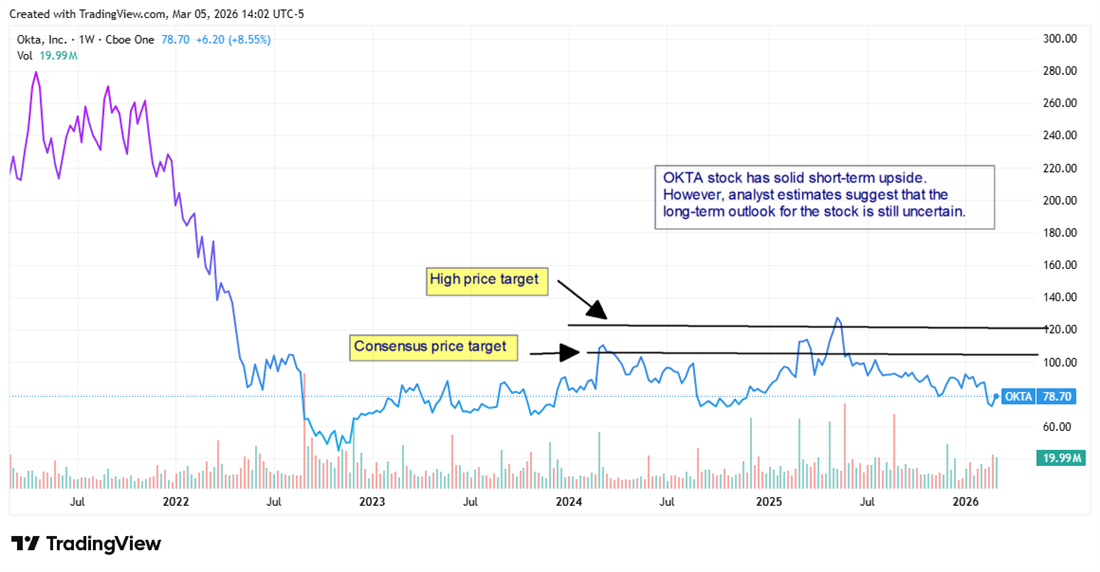
The practical takeaway: Okta looks like a reasonable trade for investors with a 6- to 12-month horizon, especially if cybersecurity tailwinds persist and the company can show modest acceleration in Current Remaining Performance Obligation (cRPO) growth in coming quarters. But for long-term investors seeking a compounding growth story, the deceleration trend and unanswered questions around AI differentiation suggest there may be better options.
BigBear.ai Stock Is Down Big, But Smart Money Is Quietly Buying
Reported by Thomas Hughes. Article Posted: 3/4/2026.
Key Points
- BigBear.ai closed 2025 at long-term lows, but debt reduction and strategic acquisitions have reshaped its financial footing heading into 2026.
- Institutions are quietly accumulating shares at a 10-to-1 buy ratio, even as short interest remains elevated above 30%.
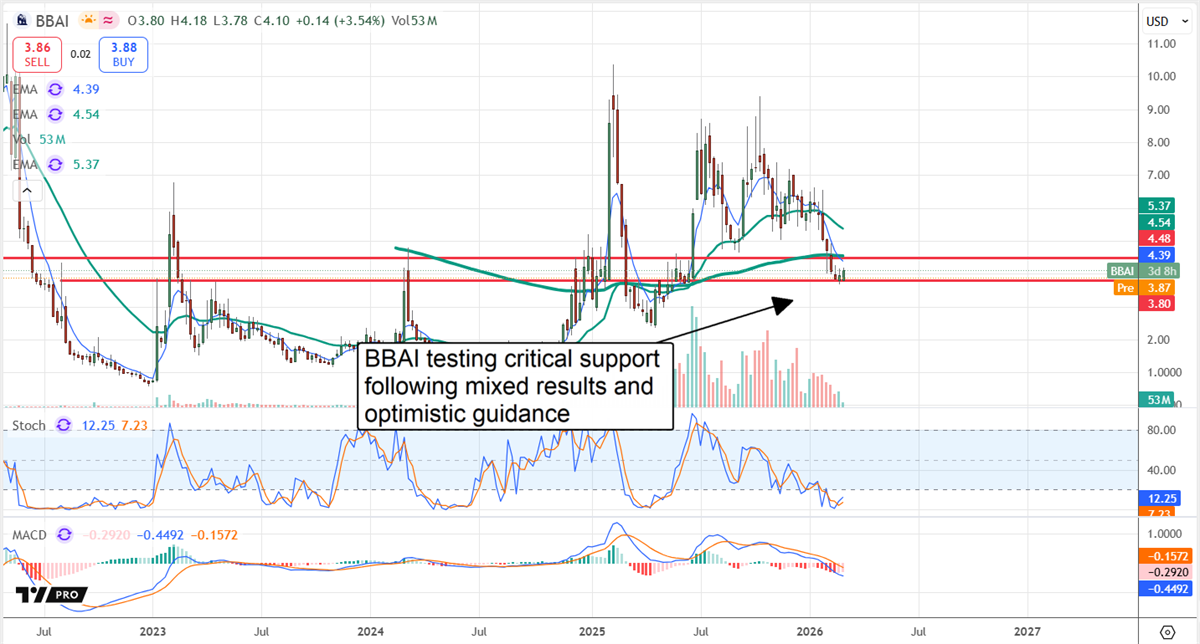
- The stock faces a pivotal test at $3.80 support—holding it could spark a rebound toward $4.50 resistance.
- Special Report: [Sponsorship-Ad-6-Format3]
There are reasons why BigBear.ai (NYSE: BBAI) stock struggled to gain traction in 2025 and fell to long-term lows, but the story is changing in 2026. Issues that kept analysts and institutions at bay — including dilution, debt, and high short interest — have been resolved or largely played out, leaving the company in a stronger position. Highlights from the 2025 year-end report and 2026 guidance include significant debt reduction, a robust capital position, and acquisitions that position the company for growth.
BigBear.ai is an emerging AI services company focused on data ingestion, predictive analytics, edge computing, and computer vision. Its products help manage large, complex data streams and provide facial and weapon recognition and secure edge computing in remote locations. Among its strengths are deep mission experience and the ability to deliver actionable intelligence from complex datasets quickly. Key clients include the U.S. Federal Government and defense and security contractors.
New Acquisitions Bring Recurring Revenue and Federal Access
Elon Musk already made me a "wealthy man" (Ad)
I Met Elon Musk "Face-to-Face"
During a private gathering of Wall Street elites, I was one of two people selected to speak with Elon personally.
As a result, my research now leads me to believe Elon will announce the SpaceX IPO on this date:
March 26, 2026. Circle it on your calendar.
I'm sharing an "access code" that lets anyone grab a pre-IPO stake before it happens. This is your invitation to the biggest wealth-building event of the decade.
Recent acquisitions include Ask Sage and Cargo Seer. Ask Sage closed in late 2025, adding a FedRAMP-certified vendor to the portfolio and broadening BigBear's access to federal markets while bringing visible recurring revenue. Cargo Seer is an AI platform built for border and customs protection, offering non-intrusive detection and faster cargo processing using computer vision and advanced algorithms. Although financials haven't been disclosed, Cargo Seer has a visible industry presence that suggests it generates revenue.
Headwinds in 2025 included reduced Army activity and one‑time items in the prior year that inflated revenue and margins. Another major headwind was a large capital raise through share sales, which increased the share count by nearly 75% and invited heavy short-selling. Short interest surged along with the share count, peaking in late 2025 at well over 30%. A potential catalyst for higher share prices is short-covering — and possibly a short squeeze — in upcoming quarters.
BigBear.ai Trades Dilution for a Cleaner Capital Structure
The impact on the balance sheet helps offset the share count dilution, assuming the company gains traction in 2026. Share sales and management actions produced a large increase in cash, marketable securities, current assets and total assets, while reducing total and net debt and overall liabilities.
The net result was a surge in equity, which rose to $611 million from a prior deficit. The cash balance may decline in the near to mid term, but it appears unlikely BigBear will need additional capital soon. Another near-term catalyst will be upcoming earnings releases, which are expected to show improved revenue, organic growth, and profitability.
Analyst Coverage Is Thin, but Institutional Buyers Are Stepping In
Analyst coverage remains thin — MarketBeat tracks only four analysts with recent reports. Those reports range from nearly a year old to under two months, and the consensus rating is a Hold (50% Hold, 25% Sell, 25% Buy).
Price targets are more optimistic, implying roughly 45% upside to $6 as of early March. Catalysts for the stock could include increased coverage, improving sentiment, and higher price targets; gains would likely be larger if analysts begin upgrading and raising their targets.
Institutional trends are likewise muted, leaving the stock vulnerable to short selling and volatile moves. Institutional ownership is only about 7.5%, but there are signs of accumulation. Institutions have been buying aggressively — roughly $10 of buys for every $1 sold — and activity ramped to near‑record highs in early 2026; they may increase the pace as the year progresses.
The charts aren't pretty. Daily and weekly charts show a market in decline, and post‑release trading followed suit. Down more than 5%, BBAI could set new lows — potentially to $3 or lower if critical support fails. If the stock holds above $3.80, a rebound could begin sooner. In that scenario, key resistance is near $4.50 and would likely draw traders when crossed.
This email is a paid sponsorship from Porter & Company, a third-party advertiser of InsiderTrades.com and MarketBeat.
If you need help with your account, please feel free to email our South Dakota based support team at contact@marketbeat.com.
If you no longer wish to receive email from InsiderTrades.com, you can unsubscribe.
Copyright 2006-2026 MarketBeat Media, LLC. All rights protected.
345 North Reid Place, Suite 620, Sioux Falls, South Dakota 57103. United States of America..


No comments:
Post a Comment