Small Colorado Company (Backed by Sam Altman) Could Save U.S. Power Grid 
Meta’s $18 Billion Settlement May Be a Win for InvestorsWritten by Leo Miller on August 28, 2026 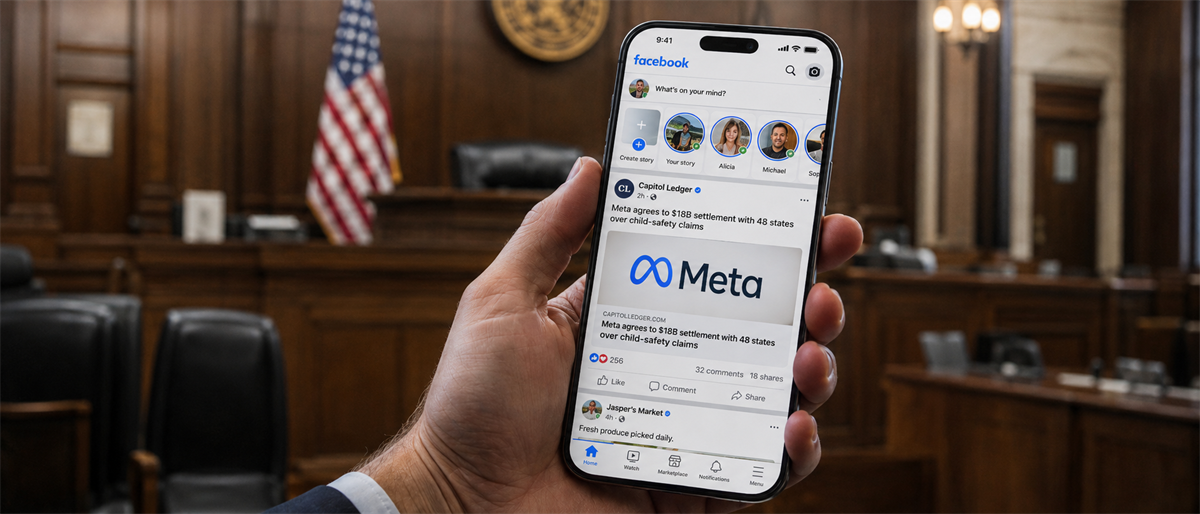
Key Points
- Meta Platforms agreed to pay up to approximately $18 billion to settle a multistate legal case over youth social media addiction.
- The settlement came in far below the roughly $200 billion in civil penalties that state plaintiffs said Meta could realistically face, substantially reducing the company’s potential legal exposure.
- Meta shares rose more than 1% on the news, suggesting investors viewed the settlement as a favorable resolution that allows attention to shift back toward the company’s AI growth strategy.
- Special Report: ALERT: Drop these 5 stocks before the market opens tomorrow!

Meta Platforms (NASDAQ: META) just put a massive legal case in the rearview mirror, albeit at a very high cost. In a legal battle that involved several U.S. states, Meta has agreed to payments of up to approximately $18 billion. While this is certainly a hefty sum, the Magnificent Seven giant may have exited this legal entanglement with a largely favorable outcome. The company avoided a result that could have led to far worse financial damage—providing a silver lining to investors amid the company's multi-month legal headwinds.
Porter Stansberry flew the Porter and Co. team 3,300 miles to Dublin to investigate a 17-year investing experiment called Project Prophet - and documented everything on film.
Rooted in the laws of physics, this quantitative approach challenges conventional wealth-building wisdom. With 17 years of verified data behind it, Porter calls it unlike anything he has seen in nearly 30 years in the business. Watch the full investigation and decide for yourself
Meta’s Settles for Far Less Than Initially FearedThe up to $18 billion payments related to Meta’s youth social media addiction case are a far cry from the massive payments the firm could have faced. Meta itself previously noted that plaintiffs in this case were seeking up to $1.4 trillion in damages. Right off the bat, it seemed highly unrealistic that Meta would ever face payments at this level, which was very close to the company’s entire market capitalization. It would have also been many times larger than the tobacco industry’s $206 billion settlement in 1998, one of the largest legal settlements ever. However, Meta’s payments will still not even come close to “more realistic” plaintiff expectations of $200 billion in damages. At up to $18 billion, Meta’s maximum payment will come in at just 9% of this $200 billion figure. Additionally, a significant portion of this payment is contingent on events that may not materialize. Of the total, guaranteed payments come in at $12.7 billion. This includes a separate $1 billion settlement reached with Texas and $459 million related to the resolution of state cases around its 2018 Cambridge Analytica scandal. The remaining sum of approximately $5 billion is contingent on broader industry action. Meta says the additional payments depend in part on Alphabet’s (NASDAQ: GOOGL) YouTube and ByteDance's TikTok adopting a one-hour daily limit, Night Mode, and age-assurance measures and making corresponding monetary payments. Overall, it is possible that Meta will not face this additional $5 billion in penalties. Separately, Meta agreed to several youth-safety measures of its own, including a two-hour daily time limit for children who use its apps and a nighttime block between midnight and 6 a.m. However, parents can voluntarily remove these restrictions. Meta Skirts Vast Algorithm Changes, Faces $10 Billion Q3 ExpenseIt appears Meta will not have to make significant changes to its algorithms as a result of this case, but will simply need to implement youth-specific features. This is important, given that carving out a separate set of algorithms for users may have been difficult, straining internal operations and complicating its engagement capabilities. Meta and the plaintiffs settled this trial in relatively short order, only around a week after it began. This indicates that Meta wanted to put the issue to bed quickly and that the plaintiffs were happy to receive the sum that they did. This dynamic could bode well for further legal scrutiny the company faces related to youth issues. It suggests that the sky-high settlement initially stated had little connection to what was actually on the table. In turn, Meta could settle for far less than those initial numbers in future cases. Financially, Meta intends to incur legal expenses of $10 billion in Q3, which will have a significant negative impact on metrics such as earnings per share (EPS). However, given that the company has disclosed it, it should not come as a surprise to investors and analysts during its next report. In turn, the charge alone is unlikely to lead to a meaningfully negative post-earnings reaction. Additionally, although its legal expenses will be actual cash charges, unlike depreciation or amortization, that cash will likely flow out over time. The company will make its payments in 10 installments, with the first coming in the next 30 days. This initial payment will come alongside $75 million in state legal costs and the Cambridge Analytica payment. Taken together, this implies a cash impact of approximately $1.7 billion in Q3, excluding the firm’s own legal expenses. The company will make subsequent payments near the beginning of each calendar year, which should be closer to $1.2 billion based on current guaranteed payments. From a cash flow perspective, this is a very solid outcome for the company. It allows Meta to see a relatively small outflow each year, rather than making a large upfront payment.
Marc Chaikin, founder of Chaikin Analytics, is sharing a strategy he calls 'Sell This, Buy That' - a way to move out of overpriced AI stocks before the tech trade breaks down and into lesser-known names with real potential to challenge the Mag 7.
One pick he calls 'an upgrade to Tesla stock' is a little-known company that just inked a partnership with Nvidia, positioning it ahead of Tesla in the autonomous vehicle race. Get the name, ticker, and full Hotlist before markets open
All Eyes Turn Back to AIDespite the commitment to billions in payments, the market reacted positively to the news. Meta shares closed up by more than 1% on Aug. 26 while the S&P 500 Index was flat on the day. This implies that investors viewed this as a favorable outcome for the company. That is not overly surprising, given how much larger the settlement could have been. For investors, the result of Meta’s trial is largely positive. It removes a high-profile headwind around the company and allows markets to focus squarely on the company’s AI outlook. However, the trial serves as a clear reminder of the legal risk surrounding Meta—a risk that investors should not dismiss, as it may reemerge. Read this article online › Read More

Did you find this article useful?  
|




No comments:
Post a Comment