Key Points
- Microsoft has pulled back after a sharp post-earnings rally, putting the stock’s recent recovery back under scrutiny.
- Azure growth, a large contracted backlog and aggressive AI infrastructure spending remain central to the Microsoft investment case.
- Investors are weighing whether the recent dip is a healthy reset or the start of a deeper reassessment of the stock.
- Special Report: Trump’s emergency move imminent
Microsoft (NASDAQ: MSFT) stock surged roughly 30% in the three weeks following its Q4 report for fiscal year 2026 (FY2026).
That made it one of the biggest winners of the tech earnings season. It also reversed a sell-off that had felt overdone.
However, MSFT just gave back part of its August rally. Shares are down nearly 8% from a recent high near $520.
For anyone who watched the stock rip from $440 to $520 in three weeks and felt like the train had left the station, this dip reads like an opportunity.
Microsoft Stock's Pullback Looks Worse Than the Business
Price action drives headlines faster than earnings reports. That's the perception-versus-fundamentals gap in action. Microsoft stock has pulled back sharply from its all-time closing high near $538, and the recent slide from around $520 adds a fresh layer of anxiety for anyone who bought the August breakout.
But a pullback in a stock and a pullback in the underlying business are two different animals. Right now, only one of them is actually happening.
Microsoft's Fundamentals Keep Getting Stronger
Microsoft's Q4 FY2026 results gave bulls almost everything they could ask for. Revenue hit $90 billion, up 18% year-over-year, while Azure crossed $100 billion in annual revenue for the first time. Contracted backlog reached $678 billion, giving investors more visibility into future AI spending than most rivals can offer. Azure itself grew 43% in the quarter, and Microsoft 365 Copilot passed 30 million paid seats.
That backlog number is perhaps the most important. It jumped by roughly $51 billion in a single quarter. It represents signed revenue waiting to convert. Companies don't commit $190 billion to capital expenditures (CapEx) on hope.
Management has repeatedly said demand for AI-enabled cloud capacity is outrunning what the company can currently supply. A company that's supply-constrained on its fastest-growing product isn't the one investors should worry about.
Microsoft's AI Spending Is a Hyperscaler-Wide Concern
Free cash flow has compressed as Microsoft plows record sums into GPUs and data centers, and that's the number bears keep circling. It's a legitimate line to watch. But it isn't unique to Microsoft.
Every hyperscaler is running the same playbook. Alphabet (NASDAQ: GOOGL), Amazon (NASDAQ: AMZN), and Meta Platforms (NASDAQ: META) have all raised their own 2026 capital spending guidance in recent months.
The credit market noise adds to the confusion. Hyperscalers, including Microsoft, have more than doubled their collective debt load over the past year to fund the buildout. Bond investors are paying closer attention, and demand for hyperscaler bonds has thinned somewhat from earlier in the year.
But analysts covering this debt are largely consistent on one point: these companies aren't in financial distress. The financing is simply moving further off-balance sheet, into private credit and leasing structures that are harder for the average investor to see. That's a sector-wide question worth monitoring over the next several years. But it says nothing specific about whether Microsoft's core Azure business is healthy today.
MSFT Chart Shows a Constructive Setup
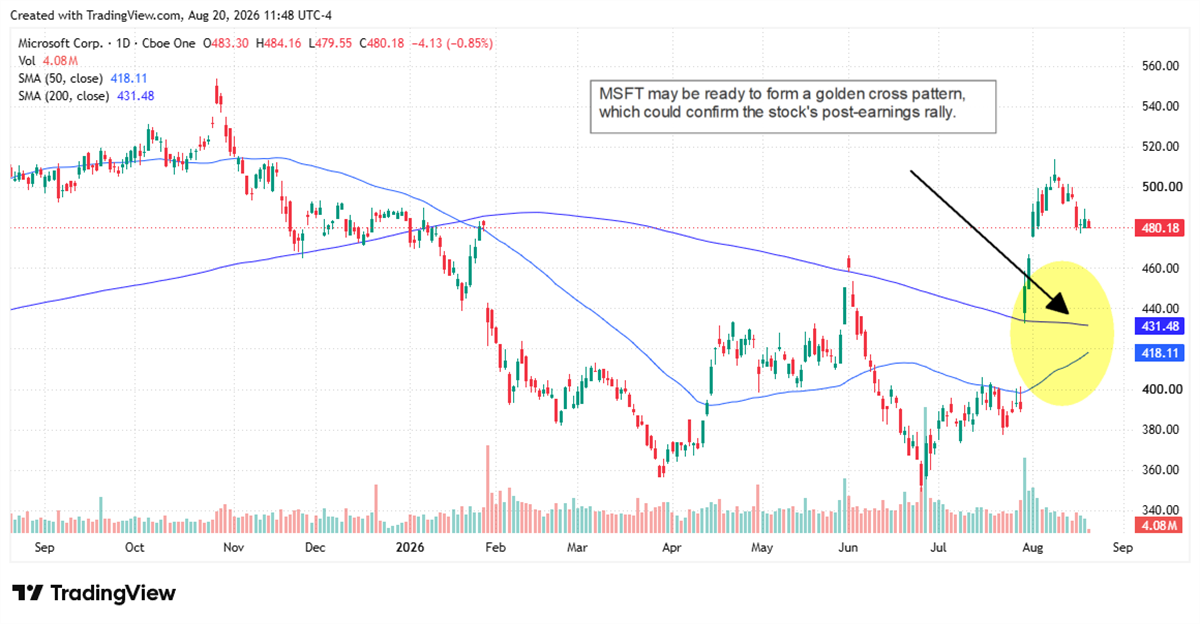
Zoom out on the chart, and the sell-off looks less like a breakdown and more like digestion after a violent recovery. Microsoft's 50-day moving average sits at $418.11, still below the 200-day at $431.48, but the gap has narrowed sharply since the stock's April lows near $345.
If the 50-day continues climbing at its current pace, a golden cross — the 50-day crossing above the 200-day—is a realistic setup over the coming weeks. That crossover doesn't guarantee anything on its own, but it typically confirms an intermediate-term trend shift rather than just a headline price bounce.
Just as important, this week's pullback found support right around the $480 level, which had acted as resistance in June and July. Old resistance becoming new support is a classic technical tell that the breakout above it was rooted in real demand.
Microsoft's Pullback Could Give Investors a Second Chance
Investors who sat out Microsoft's April-to-August recovery watched the stock nearly double off its lows and understandably felt like they'd missed the move. A stock that runs hard without you creates a very human urge to wait for the next dip, only to talk yourself out of buying it when it shows up, because the headlines during the dip sound worse than the ones during the run.
This week is that dip. The business didn't get worse between last Thursday and today. Azure demand still exceeds supply. The backlog is still growing faster than the stock can price it in. The CapEx concerns are real, but they belong to the entire hyperscaler cohort, not to Microsoft alone.
Read this article online ›

The best investment opportunities don't wait. Get our research and stock ideas delivered straight to your smartphone—so you never miss a market-moving opportunity. Our text alerts ensure you see timely stock ideas and professional research reports instantly, whether you're in a meeting, commuting, or away from your desk.
Get Text Alerts from American Market News (free)


No comments:
Post a Comment