|
A message from our friends at i2i Marketing Group, LLC

It Started at Alabama. Now It's Spreading What started at the University of Alabama is no longer isolated. The same model is now active across multiple major programs - including Ole Miss, Colorado, and Vanderbilt. These are schools where athlete-driven revenue is increasing and demand is becoming more dynamic. That matters because it shows something important:
This isn't a one-off idea. It's a system that can be applied across the country. One Nasdaq company is already positioned inside that expansion. And as more universities adopt similar models, the opportunity may scale faster than expected. See How It's Expanding >
This Month's Featured Article
Mondelez Rips Higher on a Q1 Beat as Cocoa Pressure Finally Starts to CrackReported by Chris Markoch. Article Published: 4/30/2026. 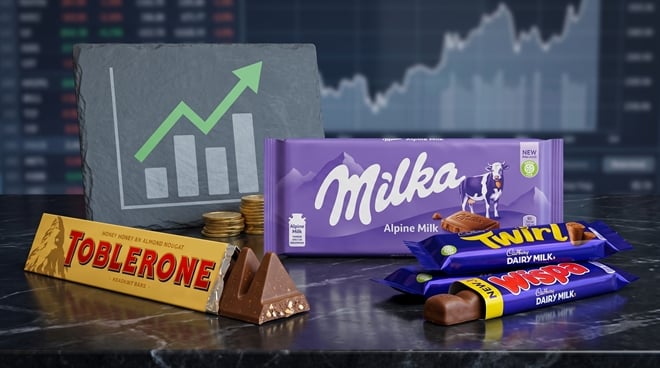
Key Points
- Mondelez stock surged after a Q1 earnings beat, with revenue and EPS topping estimates despite year-over-year margin pressure from higher cocoa costs.
- Falling cocoa prices and strong volume-driven growth in emerging markets could support upside to current earnings forecasts.
- Technical signals and weak developed-market consumer trends suggest investors should watch for a potential pullback despite improving fundamentals.
- Special Report: These AI stocks could go to zero. Here's why.

Mondelez International (NASDAQ: MDLZ) is up more than 5% after the company delivered strong first-quarter earnings. The report came on a day when oil prices were moving higher, prompting investors to seek out value stocks.
At 32x earnings, some investors would push back on the idea that MDLZ is a value stock. But forward earnings of about 20x suggest that it could be a value play. The company’s results point to a resilient consumer. In addition, one of the largest headwinds to earnings may be moving in a positive direction. That means the current estimate for earnings growth of around 11.8% may be too low. Strong Earnings Beat Highlights Margin Pressure and Growth CatalystsMondelez reported adjusted earnings per share (EPS) of 67 cents, beating estimates of 61 cents. Revenue of $10.08 billion came in above expectations of $9.76 billion. On a year-over-year basis, the picture was more mixed. Revenue was about 8% higher than the $9.31 billion reported in Q1 2025, but earnings were 9.4% lower than the 74 cents the company delivered in the prior-year quarter. That may have some analysts thinking the story for Mondelez reflects the same price/volume puzzle facing many consumer-facing stocks. But there are two important distinctions that could suggest more growth may be ahead. Cocoa Prices Are Coming DownThere are times when companies cite a reason for weak results that doesn’t pass the smell test. Or, in the case of Mondelez, the taste test. That doesn’t appear to be the case here, as the company’s results showed that the single biggest factor impacting adjusted EPS was higher cocoa prices. Cocoa prices spiked sharply at the beginning of 2025, but have been moving lower over the last year. Management expects that trend to continue for the rest of 2026. That would allow room for earnings to grow, independent of what’s happening with the consumer. For its part, Mondelez reiterated its guidance for 2026. That would be organic revenue growth of flat to 2% higher and adjusted EPS growth of flat to 5% at constant currency. The company is also forecasting about $3 billion in free cash flow (FCF). But that may be too low if consumer demand in the United States and China catches up to what’s happening in emerging markets. Emerging Markets Have a Sweet ToothOne of the highlights in the Mondelez earnings report was higher sales in emerging markets across all categories. The results were strongest in the Asia, Middle East, and Africa (AMEA) region, which posted 11.3% organic growth. But, as is frequently the case, the headline is not the whole story. And in this case, it’s not even the most important part. The key point is that growth in emerging markets is being driven by volume. Consumers are buying more, not just paying more for what they buy. The latter has been the case with many consumer staples companies. So Mondelez being able to rely on volume growth is significant. That said, emerging markets account for about 40% of Mondelez’s revenue. Developed markets account for the majority, and those markets are showing signs of improvement. The company stated that it's nearly finished with its negotiations with European Union retailers, and prices will be in line with expectations. Mondelez is also reporting stabilization in European chocolate, specifically in North America. Why Investors May Want to Be CarefulEven after the strong post-earnings move, MDLZ is trading in the middle of its 52-week range. The consensus price target of $67 still leaves about 7% upside to the 52-week high. That said, investors may want to be careful. MDLZ spiked above its 50-day simple moving average (SMA), but it is nearing overbought territory based on its relative strength indicator. That suggests momentum may be leaning toward a pullback. 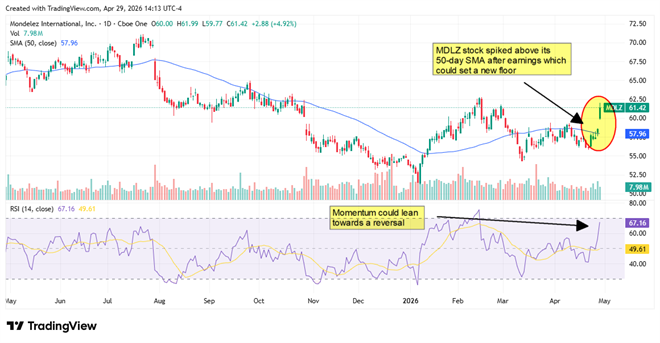
But the note of caution is not only rooted in technical signals. Mondelez chief executive officer (CEO) Dirk Van de Put noted that U.S. consumer confidence is being shaken due to the Iran war. On the earnings call, Van de Put remarked that lower-income consumers are focused on cheaper items and are being selective about when and what they buy. That’s not news, and consumer sentiment can change abruptly. But for now, investors seem to be viewing Van de Put’s comment as backward-looking and not impacting the company’s performance. A potentially larger concern to watch is Mondelez’s cash situation. For the quarter, FCF dropped sharply year over year from $815 million to $155 million. The company paid $600 million in dividends during the quarter. Assuming FCF should increase alongside earnings, this shouldn’t impact the dividend, but with a payout ratio that’s at around 106% of trailing 12-month earnings, it’s something to watch in future quarters. |




No comments:
Post a Comment