Today: Top portal addition for each top-25 team, the best CBB conference, Bracketology predictions, and the most portal departures. |
|
|
 | ~11 minute read (2,303 words) | | |
|
|
Top impact transfer portal addition for each Way-Too-Early top-25 program |
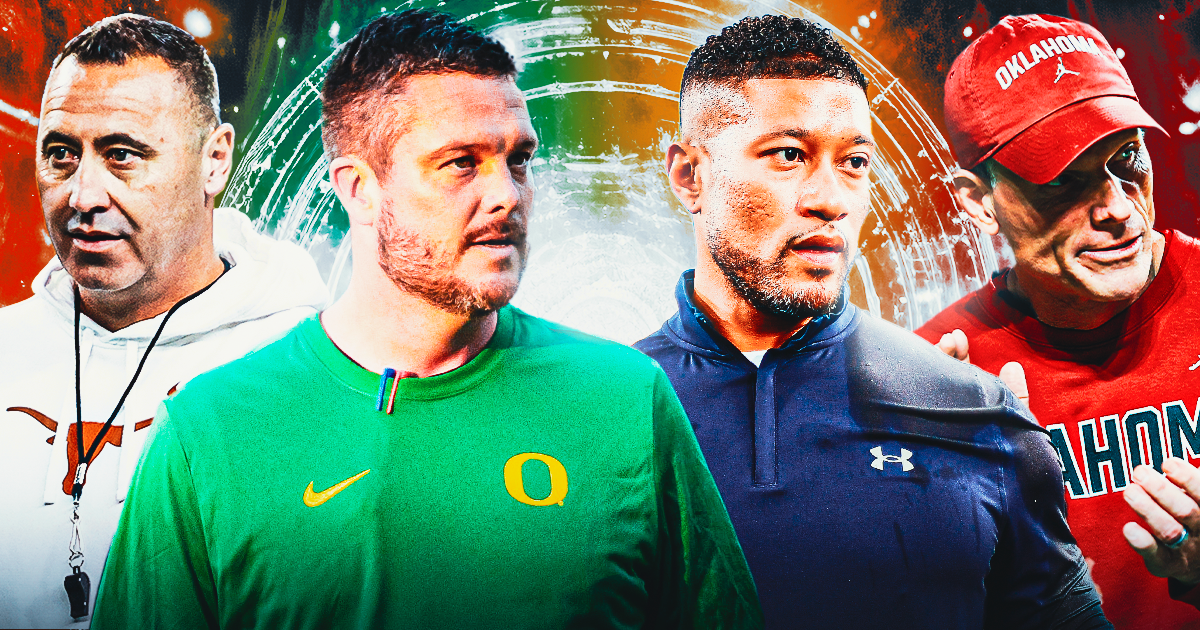
With rosters set for the 2026 season and the transfer portal window closed, On3 is taking a look at the most impactful transfer addition for each Way-Too-Early top-25 program, using the On3 composite rankings. For contenders at the top of the sport, the portal once again played a critical role in addressing roster needs and elevating championship expectations. Here is a breakdown of the top impact transfer for each team in the top 10, though the full top 25 can be seen here. 1. Ohio State: DL James Smith With All-American Kayden McDonald off to the NFL, Ohio State made defensive tackle a priority and landed Alabama transfer James Smith. A former five-star recruit, Smith emerged as a starter in 2025 and brings proven production after totaling 28 tackles, 6.5 tackles for loss, and 2.5 sacks with the Crimson Tide. 2. Indiana: WR Nick Marsh Indiana is moving forward without quarterback Fernando Mendoza, but Curt Cignetti's program upgraded its wide receiver room by landing Michigan State transfer Nick Marsh. The 6-foot-3 target gives quarterback commit Josh Hoover a proven weapon after Marsh posted 100 career catches for 1,311 yards, helping offset Elijah Sarratt's departure to the NFL. 3. Texas: WR Cam Coleman Texas identified wide receiver as a must-add position for Arch Manning and delivered by landing Auburn transfer Cam Coleman. Ranked as On3's No. 1 portal player, Coleman brings 93 career receptions for 1,306 yards and pairs with Ryan Wingo to give the Longhorns a top-tier receiving duo. 4. Georgia: WR Isiah Canion Georgia addressed a need at wide receiver after Zachariah Branch's move to the NFL by adding Georgia Tech transfer Isiah Canion. The 6-foot-4, 215-pound target gives Gunner Stockton a physical option after recording 33 catches for 480 yards in 2025. 5. Oregon: S Koi Perich Oregon beat out Texas Tech to land Minnesota safety Koi Perich, one of the most dynamic defenders in college football. With 128 tackles and six interceptions over the past two seasons, Perich steps in as the Ducks' new leader in the secondary following Dillon Thieneman's departure. 6. Notre Dame: DL Francis Brewu Notre Dame arguably landed two impact defensive linemen in Oregon's Tionne Gray and Pitt's Francis Brewu. Both are expected to contribute immediately, with Gray bringing massive size and Brewu adding proven production after posting 51 tackles, 2.5 sacks, and a forced fumble over the last two seasons. 7. Texas Tech: QB Brendan Sorsby The Red Raiders' biggest portal win came at quarterback with Cincinnati transfer Brendan Sorsby. A three-year starter, Sorsby chose Texas Tech after also visiting LSU and is expected to elevate an offense with CFP aspirations. T8. Texas A&M: EDGE Anto Saka Texas A&M added talent across the roster, but Northwestern EDGE Anto Saka stands out as a potential difference-maker. With 14 tackles for loss, 12 sacks, and three forced fumbles, Saka is expected to boost the Aggies' pass rush immediately. T8. Miami: QB Darian Mensah Fresh off a run to the national title game, Miami landed Duke quarterback Darian Mensah as its top portal addition. It marks the third straight cycle Mario Cristobal has secured a premier quarterback, with Mensah entering after going 18-9 as a starter. 10. Oklahoma: OT E'Marion Harris Oklahoma focused on protecting quarterback John Mateer by adding Arkansas offensive tackle E'Marion Harris. A 24-game starter, Harris is expected to step in immediately and solidify the Sooners' offensive line. See the top add for each top 25 program here. |
|
|
The best conference in college basketball: Big 12, Big Ten, SEC all make case as ACC gains ground |
The debate over the best conference in college basketball goes far beyond bragging rights. It is a data point that carries real weight in rankings, bracketology, and comparisons between top seeds and bubble teams. This season, unlike a year ago, the answer is far from clear. Last season offered little room for discussion. The SEC separated itself with the best teams, the most national title contenders, and a record number of NCAA Tournament bids. The 2025-26 season has produced a more complicated picture, with multiple conferences presenting compelling but very different cases. As the discussion continues, the numbers from KenPom and the NET rankings provide the clearest snapshot of where things stand before the NCAA Tournament ultimately settles the argument. Big 12 case: True contenders The Big 12's case begins at the very top. Six teams currently sit inside the AP Poll's Top 14, and nearly every program in the league looks capable of making a deep NCAA Tournament run. That level of contender density is rare and has produced marquee matchups throughout the season, with more ahead in February and March. Arizona leads the way as an undefeated team ranked No. 1 in both KenPom and the NET, and the analytics strongly support the league's elite. BYU, Houston, Iowa State, Kansas, and Texas Tech also rank inside the Top 17 of both models. Still, the Big 12's résumé shows cracks below the surface. The conference ranks No. 2 in average NET rating and third at KenPom, with only seven teams currently projected to make the NCAA Tournament. The explanation is depth. UCF is the lone non-elite team projected in the field, while Baylor and TCU are the only others hovering near the bubble. SEC case: Depth matters The SEC presents almost the inverse argument. There are no clear inner-circle national championship favorites, but the league boasts unmatched depth from top to bottom. South Carolina is the SEC's lowest-ranked team, yet still sits at No. 87 in KenPom and No. 105 in the NET. By comparison, the lowest Big 12 team ranks 116/115, while the Big Ten's worst falls to 146/170. The SEC also owns the best average NET ranking at 45.88. However, depth alone comes with limitations. The SEC placed just one team among the Top 16 overall seeds in the most recent bracketology update and has no teams on the 1, 2, or 3 seed lines, a gap that stands out next to the Big 12 and Big Ten. Big Ten case: Numbers rule The B1G attempts to strike a balance between elite teams and tournament depth. Five teams sit inside the AP Poll's Top 12, and 10 programs are projected in the NCAA Tournament, giving the league the most bids of any conference. That strength is offset by a soft underbelly. Maryland, Penn State, and Rutgers rank below the worst teams in both the Big 12 and SEC across analytic models, raising questions about whether depth at the top outweighs easy games at the bottom. ACC case: Most improved The ACC may not match the other three leagues, but its year-over-year improvement stands out. Heavy investment in coaching and the transfer portal has brought several struggling programs back into the NCAA Tournament conversation. Ranked fourth by both KenPom and the NET, the ACC features Duke as a true top-seed contender and eight teams inside the Top 50 of both models. With continued momentum, the league could even push for more total bids than the Big 12. Read the full breakdown here. |
|
|
2026 NCAA Tournament Predictions: Bracketology projections shift entering February |
With the college hoops weekend in the rear view, the results have reshaped the bracketology picture. With March inching closer, the model has shifted its approach. Rather than assigning automatic bids to the highest-rated team, the current top team in each conference standings now claims that spot. Bracketology continues to lean on the NCAA's NET Rankings, which evaluate teams by sorting wins and losses into quadrant-based categories. The goal remains the same: project how the selection committee would seed the field based on results to date, while accounting for strength of schedule and résumé-building opportunities still ahead. Using that framework, here is a look at the projected 1- and 2-seeds in each region of the latest 2026 Bracketology from On3. West region 1. Arizona: Arizona continues its undefeated march through the season, reaching 22-0 over the weekend and strengthening its case as the No. 1 overall seed. The Wildcats have separated themselves at the top of the board, with consistency across metrics backing up the résumé. Their next opportunity comes against Oklahoma State after a brief layoff. 2. Gonzaga: Gonzaga has worked its way back onto the 2-seed line, supported by a strong non-conference résumé that has kept the Zags high in the metrics through WCC play. A valuable win over St. Mary's anchors their profile, and they are favored in each of their upcoming matchups with a clear path forward South region 1. UConn: UConn remains firmly planted on the 1-seed line, continuing to assert itself despite questions about comparative strength of schedule in the Big East. The Huskies' biggest threats come from Big Ten contenders, and they can further solidify their standing with a win against Xavier. 2. Nebraska: Nebraska sits on the 2-seed line despite close losses to Michigan and Illinois. Key injuries helped limit any major slide, but they'll need to rebound this weekend against Rutgers. Midwest region 1. Michigan: Michigan remains in the No. 2 overall seed position after adding another marquee win, this time against Michigan State. The Wolverines sit on razor-thin margins when compared to Duke, but have stayed on the right side of the debate with consistent high-end victories. 2. Houston: Houston continues its upward trajectory following a win over Cincinnati. The Cougars now look ahead to a matchup with UCF, with a chance to stay near the top of the conference standings and remain in the mix to climb the seed line. East region 1. Duke: Duke remains firmly in the hunt to move even higher, staying close behind the teams above them on the bracket board. The Blue Devils continue to roll through ACC play and will look to maintain momentum against Boston College. 2. Illinois: Illinois continues to surge in the analytic models, rising among the 2-seed contenders in a Big Ten loaded with résumé-building chances. They notched a significant win yesterday at Nebraska. See the full projected bracket, including the first four out. |
|
|
Most transfer portal departures by school |
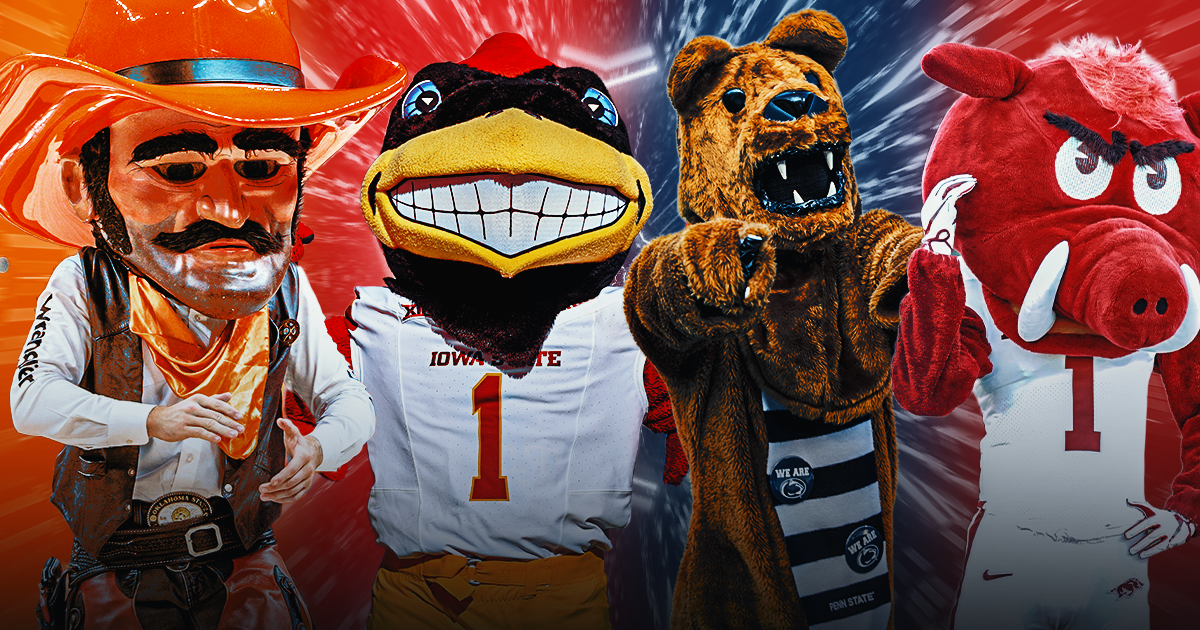
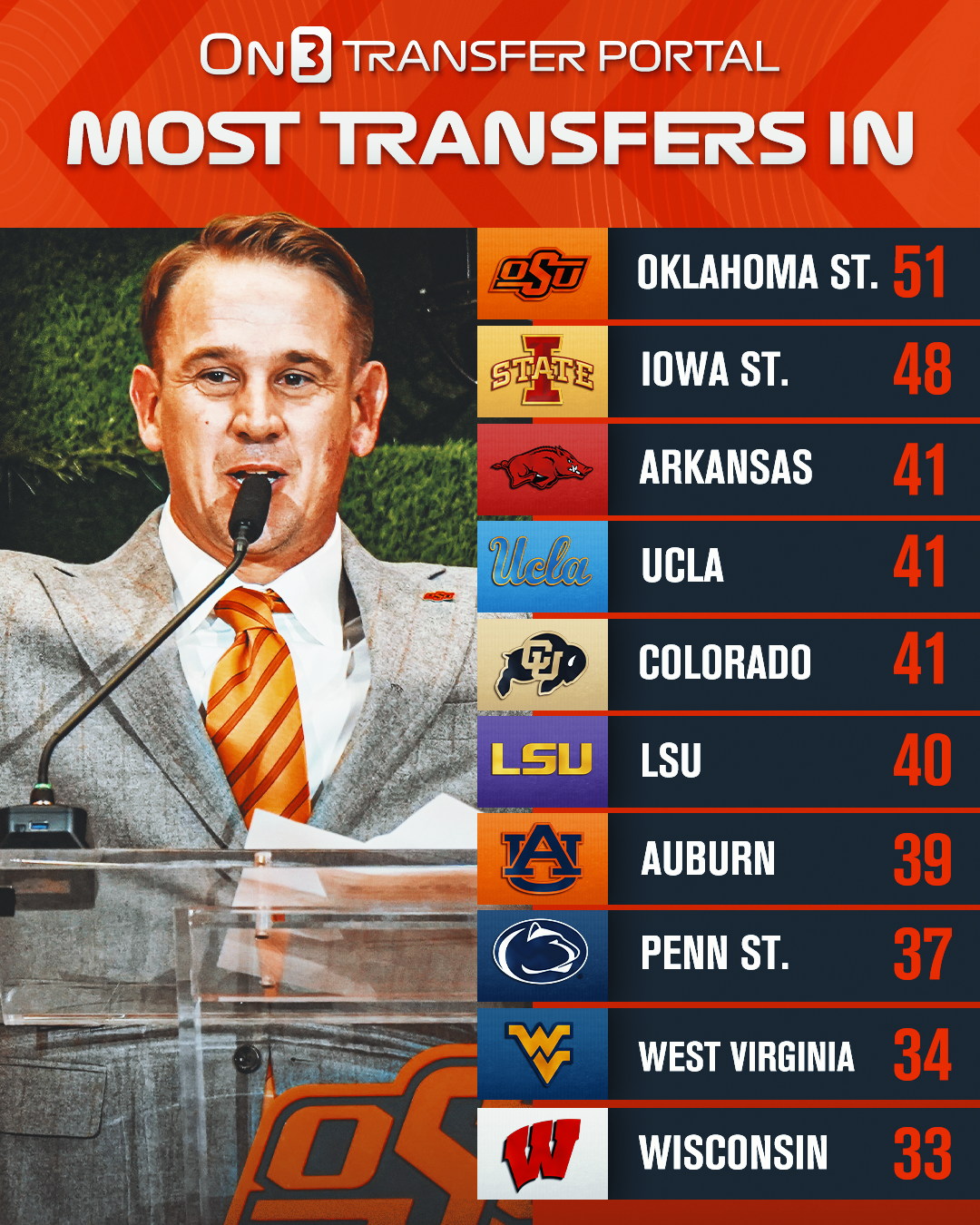
With the transfer portal window officially closed, it's time to look back at which programs were hit hardest by attrition. In many cases, coaching turnover sparked mass exits, though other factors played a role as well. Oklahoma State surpassed Colorado's 2023 record of 56 departures, with 64 players leaving the program this cycle. At the other end of the spectrum, Iowa (eight) had the fewest transfer portal entries. On3 is breaking down the most college football transfer portal departures by school. T5. Arkansas – 38 Arkansas saw 38 players enter the portal after firing Sam Pittman before the midpoint of the season and hiring Memphis coach Ryan Silverfield. Silverfield moved quickly to reshape the roster, adding 41 new players. Arkansas ranks No. 8 in the On3 Team Transfer Portal Rankings for the talent it brought in, including Kentucky EDGE Steven Soles and Michigan running back Jasper Parker. Cornerback Jaheim Singletary and offensive tackle Jac'Qawn McRoy were among the notable departures. T5. Mississippi State – 38 Entering Year 3 under Jeff Lebby, Mississippi State had 38 players hit the portal. The Bulldogs retained some key pieces, including quarterback KaMario Taylor, who is expected to step into the starting role as a sophomore in 2026. Top losses included offensive tackle Jayvin James, offensive lineman Zack Owens, cornerback Jayven Williams and defensive lineman Kedrick Bingley-Jones. Lebby added 24 players to address roster needs, including seven offensive linemen. Missouri transfer wide receiver Marquis Johnson is expected to make an immediate impact after posting 28 catches for 340 yards in 2025. 4. West Virginia – 44 Rich Rodriguez continued reshaping the West Virginia roster in his first full offseason back with the Mountaineers. Part of that process involved allowing attrition, as 44 players exited through the portal while 34 newcomers arrived. The most notable addition was Oklahoma transfer quarterback Michael Hawkins, who is expected to be the starter entering spring practice. West Virginia also lost offensive line experience with Donovan Haslam transferring to Tennessee, while wide receiver Cam Vaughn left for Miami. 3. Penn State – 46 Penn State's decision to fire James Franklin in October led to a wave of portal entries in January. New head coach Matt Campbell was able to retain some key pieces, including linebacker Tony Rojas and cornerback Daryus Dixson. Still, several players entered the portal, with some seeking a fresh start and others following Franklin to Virginia Tech. A dozen Penn State players are headed to Blacksburg, including quarterback Ethan Grunkemeyer and tight end Luke Reynolds. 2. Iowa State – 54 After years of turning down opportunities, Matt Campbell left Iowa State when Penn State went all-in during this coaching cycle. His departure triggered the loss of several cornerstone players, including quarterback Rocco Becht, tight end Benjamin Brahmer, safety Marcus Neal and cornerback Jeremiah Cooper. Campbell brought 23 Iowa State players with him to Happy Valley, giving him a familiar core to build around. Iowa State moved quickly to hire Washington State's Jimmy Rogers, who has added 48 new players in an effort to stop the bleeding, though replacing that level of talent will be difficult. 1. Oklahoma State – 64 Mike Gundy's firing just three games into the 2025 season opened a 30-day portal window for Oklahoma State players. That early opportunity, combined with a second portal window in January, led to a mass exodus. New head coach Eric Morris arrived from North Texas and rebuilt the roster quickly, adding 54 transfers. That group includes former Mean Green standouts quarterback Drew Mestemaker and running back Caleb Hawkins. Notable portal losses for the Cowboys included EDGE Wendell Gregory, wide receiver Jaylen Lloyd and offensive lineman Noah McKinney. Read the full breakdown from Pete Nakos. |
|
|
Below, you'll find 3 facts about a random college football player. You'll try to guess who the player is based on the facts. Let's go. I led Urban Meyer's Utah to a perfect 12–0 season, helping the Utes crash the BCS as a non-power conference team and finish in the national top five.
- In my final season at Utah, I was a first-team All-American, won Mountain West Offensive Player of the Year, and finished fourth in the Heisman Trophy voting.
- I was the No. 1 overall pick in the NFL Draft, later suffered a devastating leg injury that nearly cost me my career, then returned to win NFL Comeback Player of the Year.
Answer at the bottom. |
|
|
2026 programs with the most transfers in |
|
|
Join now to unlock the best of college and high school sports from our trusted team of insiders. Join for $1. Cancel anytime. |
|
|
Not subscribed to On3? Subscribe here for all the news and analysis from our network of insiders. |
2970 Foster Creighton Drive, Nashville, TN 37204 |
©2026 On3 Media. All rights reserved. |
|
|
|





No comments:
Post a Comment