It’s disgraceful.
The United States, a country that once stood for personal freedom, yet demanded personal responsibility from its citizens and politicians alike, is broken.
I barely recognize it anymore.
Since 2010, I’ve been warning everyone who would listen about the United State’s looming debt crisis in my documentary, The End of America.
Now, 16 years, and $22 trillion in additional debt later…
We’re very near the $40 trillion mark in total national debt:

This massive debt… annual deficit increases… along with looming unfunded pension obligations, are spiraling this country toward insolvency.
And as I’ll show you, the soaring price of gold right now is a very clear warning of this.
Congress cannot possibly finance its legislatively mandated spending:
Mandatory spending plus interest is locked in at around 37% of GDP before a single discretionary dollar is spent.
It’s inevitable that the government will be forced to print trillions of dollars to finance its growing obligations and borrowing costs.
This has the potential to trigger a technical U.S. Treasury default… which would mean catastrophic losses for long-duration bond investors.
It’s happening right now in Japan, where the 10-year bond yield has tripled over the last year. It has cost investors over $200 billion.
And that’s what happened in Great Britain in September 2022, costing investors around $700 billion.
In both cases, the bond markets sold off after the governments announced plans to both increase spending and cut taxes. Following the same logic at home…
I believe it’s now certain America will soon experience a financial reckoning, much like we saw in 1973-1974.
After the U.S. abandoned the gold standard in August 1971, Congress passed huge increases to spending, including linking Social Security payouts to meet the inflation rate.
In the 10 years following the August 1971 break with gold, the size of the Federal Reserve’s balance sheet grew 174%, from $70 billion to over $190 billion, as it bought enormous amounts of Treasury bonds with newly printed money.
This set off the roaring inflation of the 1970s, which wiped out long-duration Treasury bonds.
That meant a stock market decline of more than 50% between 1973 and 1974. The sell-off in financial stocks was even more intense.
For banks, which must hold Treasury securities as reserves, the technical default (printing money to finance government debt) was catastrophic.
The price of gold, in the meantime? Soared from $35/ounce to $455 by the end of the decade. That should sound familiar…
Today, we’re witnessing the largest gold bull run since the 1970s, and for an important reason:
Central banks around the world are recognizing this massive risk that U.S. Treasury bonds pose to their bottom line. So they’re dumping Treasuries… and buying gold hand-over-fist.
Put simply, gold is money again. And it’s the greatest monetary shift we’ve ever seen.
I warned anyone who would listen to get into gold over a year ago. And I’d bet the ones who did are enjoying some incredible returns.
But this is just the beginning of this wealth shift - and I have a new gold recommendation that I believe everyone should consider immediately.
In short, if you don’t own gold right now, you’re making a big mistake. But if you really want to protect and potentially grow your wealth during these dangerous times…
Click here to see the absolute best way to invest in this global gold rush right now.
Good investing,
Porter Stansberry
3 Leveraged Gold Picks That Can Turn Small Moves Into Big Ones
Authored by Nathan Reiff. Published: 2/8/2026.

At a Glance
- Despite a recent reversal, the price of gold is up 68% in the past year—and the price of shares of some gold mining companies has risen at an even faster rate.
- Investors willing to accept a high degree of risk in exchange for the potential to magnify single-day gains in gold or gold mining stocks might consider a leveraged ETF or ETN.
- Both 2x and 3x leveraged exposure is available via products such as SHNY, GDXU, and JNUG, although these are designed for experienced investors and remain highly speculative investments.
A sudden reversal in the precious metals rally has left investors once again reassessing how gold should fit into their portfolios.
Despite the per-ounce price plunging hundreds of dollars from an all-time high of around $5,600, gold is up 68% over the past year — and the first days of February have brought a modest recovery from the recent dip.
Have $500? Invest in Elon's AI Masterplan (Ad)
What if you could claim a stake in what's set to be the biggest IPO ever… starting with just $500?
Everyone is talking about Elon Musk's SpaceX IPO.
One thing is clear: investors should expect high volatility in gold's price. Given that, it's possible to achieve outsized returns beyond simply holding physical gold or shares in gold mining stocks by targeting exchange-traded funds (ETFs) or similar products that employ leverage.
All leveraged exchange-traded products (ETPs) carry a high degree of risk and are not appropriate for many investment strategies. Still, the following three funds may stand out to investors willing to make a big bet on gold.
A Rare 3X Leveraged Play on the Price of Gold
The MicroSectors Gold 3X Leveraged ETNs (NYSEARCA: SHNY) is an exchange-traded note targeting the price of gold bullion. It offers 3x daily leverage, aiming to triple daily moves in gold — and losses are amplified similarly.
SHNY doesn't hold physical gold directly; instead it provides leveraged exposure to the SPDR Gold Shares ETF (NYSEARCA: GLD), which stores gold bullion and is a popular access point for investors seeking exposure to the metal.
SHNY is a more extreme leveraged physical-gold play because of its 3x exposure. That makes it appropriate for investors who are highly confident in short-term, single-day price increases in gold. For those seeking a somewhat more moderate risk/reward profile, an alternative leveraged ETN—the DB Gold Double Long ETN (NYSEARCA: DGP)—provides 2x leveraged exposure to gold futures.
Despite its risks, SHNY has an expense ratio of 0.95% and averaged more than 184,000 in trading volume over a recent one-month period, making it a relatively liquid way for gold bulls to capitalize on large upward moves in the metal.
Capitalizing on Gold Mining Companies That Have Outpaced Gold's Gains
The MicroSectors Gold Miners 3X Leveraged ETN (NYSEARCA: GDXU) is a sibling to SHNY but focuses on gold mining stocks rather than bullion. Like SHNY, GDXU provides 3x leverage and achieves this by holding other ETPs.
The GDXU's holdings include the VanEck Gold Miners ETF (NYSEARCA: GDX) and the VanEck Junior Gold Miners ETF (NYSEARCA: GDXJ). Together, these ETFs offer exposure to gold mining stocks across a range of market capitalizations.
Gold miners provide indirect exposure to the price of gold. While they often move with gold, miners are also affected by other factors such as prices of other metals they produce, company operations, and geopolitical issues. For that reason, GDXU may appeal to investors who want exposure to miners' upside during a metals rally while gaining some diversification from bullion itself.
The GDX and the GDXJ are up 126.7% and 136.5%, respectively, over the past year — outpacing gold — which has given GDXU ample opportunities to deliver sizable leveraged gains for traders.
The fund carries an expense ratio of 0.95% and its average daily trading volume is substantially higher than SHNY's, which may appeal to investors who are concerned about liquidity.
A Junior Gold Mining ETF With a Dividend Bonus
The Direxion Daily Junior Gold Miners Index Bull 2X Shares (NYSEARCA: JNUG) provides 2x leverage on junior gold mining stocks.
JNUG offers a more modest leverage profile at 2x and pays a dividend that yields 0.95%, which helps offset part of its expense ratio of 1.02%.
JNUG is primarily based on the GDXJ — with additional holdings used to implement its leverage — giving it exposure to small- and mid-cap gold mining firms. Compared to the broader GDX, JNUG has a narrower focus on junior miners and may appeal to investors targeting smaller names that could experience significant growth during an extended gold rally. Keep in mind junior miners — and leveraged products in general — can be especially volatile and are best suited to experienced traders or short-term strategies.
Nintendo Stock Falls 20%—But the Rebound Case Is Growing
Authored by Chris Markoch. Published: 2/6/2026.
Article Highlights
- Nintendo shares have pulled back sharply despite strong console-unit milestones, creating a potential 2026 rebound setup.
- Engagement, software releases, and brand licensing could support Switch2 ecosystem growth through 2026.
- Easing input costs and supply-chain shifts may help margins, while technicals suggest oversold conditions.
In the first half of 2025, Nintendo (OTCMKTS: NTDOY) was not only one of the best-performing consumer discretionary stocks but a market standout as well. It surged 76% in anticipation of the company's long-awaited Switch2 release. But traders didn't stay long: the stock is down about 20% over the last 12 months and more than 18% year-to-date as of Feb. 5.
It wasn't that Switch2 sales disappointed outright. The company has sold 155.4 million units of its new console, surpassing the previous record of 154 million units set by the Nintendo DS. Still, investors had hoped for a stronger number, and that disappointment helped drive lower profit figures, cautious forward guidance, tariff concerns, and softer-than-expected holiday demand.
Have $500? Invest in Elon's AI Masterplan (Ad)
What if you could claim a stake in what's set to be the biggest IPO ever… starting with just $500?
Everyone is talking about Elon Musk's SpaceX IPO.
That said, this may be a case of a stock dropping so much it becomes attractive. Several catalysts suggest 2026 could be a rebound year for NTDOY.
The Best May Be Yet to Come for Switch2 Sales
Nintendo's latest investor presentation hints that the strongest growth phase for the Switch2 ecosystem may still be ahead. The company said active monthly users reached an all-time high, with engagement rising nearly 25% year-over-year.
That's an encouraging sign that players are not just buying consoles but staying within the ecosystem. The paid Nintendo Switch Online membership base also expanded, and the attach rate improved following the launch of more bundled hardware options.
2026 will also see Switch2 versions of many of Nintendo's most popular titles. Alongside upcoming releases tied to "The Legend of Zelda" and "Splatoon" franchises, Nintendo confirmed ongoing development of a next‑generation game engine, which could boost long-tail monetization for Switch2.
These developments give investors reason to view 2026 as a platform-expansion year rather than a late-cycle phase.
Adding to the excitement, Super Mario turns 40 this year. To celebrate, a "Super Mario Galaxy" movie will be released. The box-office success of "The Super Mario Bros. Movie" in 2023 nearly doubled the brand's licensing revenue, and management reiterated plans for cross-promotional campaigns intended to convert movie audiences into active players. If "Galaxy" performs similarly, it could spur both console and software demand heading into the holiday season.
Cost and Tariff Headwinds Could Ease
Recent margin pressure stemmed from higher memory component prices and elevated transport and tariff expenses. Management said during the presentation that those headwinds are beginning to moderate. Contract memory prices started declining in early 2026, and costs for NAND and DDR5 components have shown early signs of stabilization.
Nintendo also noted it is diversifying its supply chain outside of China and increasing local assembly in Vietnam. Those steps should help hedge against prolonged tariff risks. Combined with favorable foreign-exchange positions, it suggests much of the recent cost compression may prove temporary.
Why the Thesis Could Be Wrong
The bullish case assumes Switch2 remains the dominant platform through 2026, but several risks exist. Consumer fatigue could set in if Nintendo's first‑party lineup slows, especially with Sony Group (NYSE: SONY) and Microsoft (NASDAQ: MSFT) expected to introduce hardware refreshes this year.
Hardware margins also remain sensitive to component pricing—memory and silicon costs could rebound rather than normalize. In that scenario, Nintendo's profitability could stay under pressure longer than investors expect. And while franchise-based films have driven engagement, movie tie-ins are unpredictable; disappointing box-office results could hurt sentiment and licensing revenue.
Finally, the industry's shift toward cloud and subscription ecosystems poses a strategic challenge. Nintendo's slower, more conservative approach to online monetization could leave it trailing competitors on recurring revenue if player preferences shift faster than anticipated.
The NTDOY Chart Supports the Comeback Story
For investors who buy the bullish thesis for Switch2 sales, the next question is whether now is a good entry point. The chart makes a case for yes.
Recent selling pushed the stock below its lower Bollinger Band, a technical condition that often signals an oversold market and potential trend reversal. NTDOY has frequently responded to similar signals with rebounds.
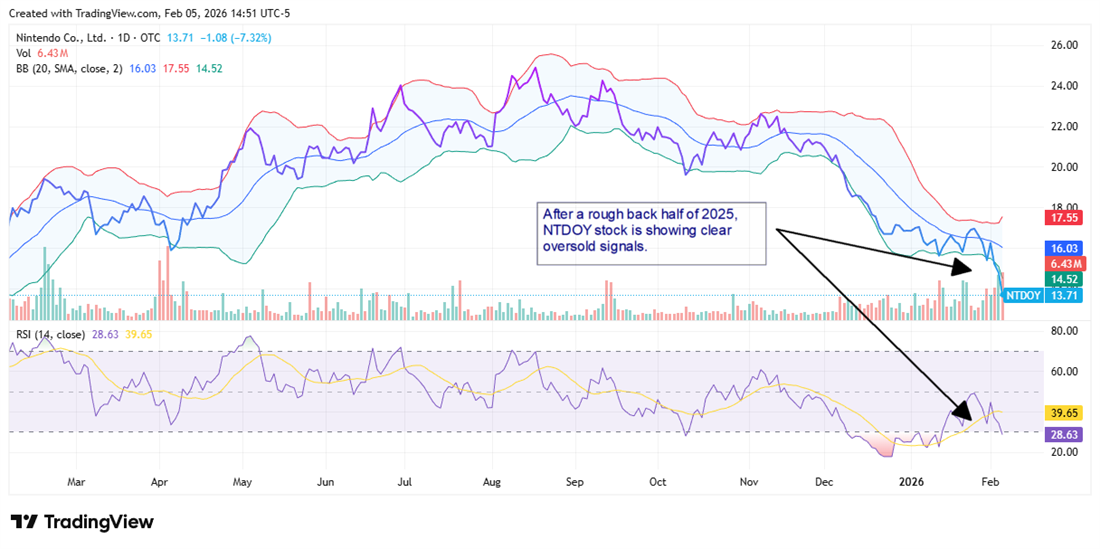
The stock is also oversold on momentum measures—the relative strength index (RSI) sits at about 28.6. Individually, neither the Bollinger Band breach nor the low RSI is a confirmed buy signal. Together, however, they suggest sentiment could shift.
If that shift occurs, investors should watch for NTDOY to reclaim the 20-day simple moving average (SMA). That move would represent roughly a 17% gain from the current price at the time of writing.
This message is a paid advertisement for Porter & Company, a third-party advertiser of MarketBeat. Why was I sent this message?.
If you have questions about your account, please email MarketBeat's U.S. based support team at contact@marketbeat.com.
If you would no longer like to receive promotional emails from MarketBeat advertisers, you can unsubscribe or manage your mailing preferences here.
© 2006-2026 MarketBeat Media, LLC.
345 N Reid Pl. #620, Sioux Falls, SD 57103. U.S.A..




No comments:
Post a Comment