Nobody noticed yet… but they will.
We just reached the end of an economic age.
Something that usually takes decades, even centuries, to play out just happened in what seems like a blink of an eye.
Unless you understand the magnitude of what just happened, you could risk losing everything you’ve worked so hard to achieve because this collapse is only just getting started.
You see, for our entire life, the story arc has been clean: it was the relentless rise, in both wealth and status, of a broad social class of professionals but that rainbow is now at an end.
Because for the first time ever, capital can now compound without additional labor.
The centuries-old relationship where job creation and GDP rose together has snapped and the economy can now scale without bringing workers along for the ride.
And this “snap” is about to change everything.
This is one of those moments in which I believe vast fortunes will be made and lost. I’m talking about a generational transfer of wealth… the type that can either enrich you or potentially impoverish you, based on the decisions you make.
Because history shows us that while these shifts always lead to catastrophic losses for those who refuse to prepare… they also unleash unprecedented wealth building potential for those who understand, and harness, the forces at work.
And this isn’t a prediction. It’s happening right now.
It’s why, although we’re seeing massive headline economic growth, the average American is being left behind.
AI Engels’ Pause
They don’t teach you this in school, but they should.
During the Industrial Revolution, Friedrich Engels noticed that although the revolution was making Britain incredibly rich when measured via GDP… the vast majority of British people were living in hell.
Between 1790 and 1840 Britain’s GDP exploded. The steam engine created massive efficiency gains, corporate profits doubled, and the stock market soared.
But for the average worker, real wages remained flat or fell… the average life expectancy in some industrial cities collapsed to just 35 years…
It was as though someone had pressed a giant “Pause” button on quality of life for the working class.
Of course, the wealth did eventually trickle down but it was half a century later and during that half century, the societal devastation was dire. It took two full generations for the labor market to adjust.
And the weavers who lost their jobs to power looms, they didn't become "machine repairmen."
They starved. They rioted. They were shot by the military or shipped to penal colonies. And it was Engels’ Pause that gave birth to Marxism.
And we’re seeing this again with AI.
The only difference is, this time it won’t take decades to play out. It took the radio 38 years to reach 50 million users. Television took 13. The internet took 4. But ChatGPT hit 100 million users in two months.
We are effectively speed-running the 19th century. We’re compressing 50 years of displacement into less than a decade… and this time the disruption isn’t coming for the illiterate farmhand…
It’s coming for the accountant. It’s coming for the lawyer. It’s coming for you and me.
Right now, knowledge work makes up roughly 50% of America’s GDP and much of that is at risk of automation in the next handful of years.
We’re talking about 5 million white-collar jobs — the bedrock of the American tax base – facing extinction over the next few years. Just take a look at the most recent cuts:
- U.S. Government: 307,000 employees
- UPS: 78,000 employees
- Amazon: 30,000 employees
- Intel: 25,000 employees
- Nissan: 20,000 employees
- Nestle: 16,000 employees
- Microsoft: 15,000 employees
- Bosch: 13,000 employees
- Dell: 12,000 employees
- Verizon: 13,000 employees
- Accenture: 11,000 employees
- Ford: 11,000 employees
- Novo Nordisk: 9,000 employees
- Microsoft: 7,000 employees
- PwC: 5,600 employees
- Salesforce: 4,000 employees
- IBM: 2,700 employees
- American Airlines: 2,700 employees
- Paramount: 2,000 employees
- Target: 1,800 employees
- General Motors: 1,500 employees
- Applied Materials: 1,444 employees
- Kroger: 1,000 employees
- Meta: 1,000 employees
It’s why AI is not just a productivity or efficiency tool, like everyone thinks, it’s a Labor Replacement Engine. And it’s why there’s such a gaping disconnect between the “real” economy and the stock market.
It’s why all the President’s claims of a “booming” economy don’t feel real for the tens of millions of people who don’t own assets.
It’s why, even though markets are hitting all-time highs, households are falling further and further behind. And this wealth divide is only going to be amplified as AI is integrated into every aspect of the economy.
IMF Managing Director Kristalina Georgieva just warned that artificial intelligence will hit the labor market like a “tsunami.”
The changes this will bring to the economy, stock market, and financial system are unprecedented. Which is why it’s critical that you watch my interview with Luke Lango.
We explain how all of these forces are converging to trigger an economic “reset” the likes of which we haven’t seen in 250 years – one that could trigger the greatest transfer of wealth in American history.
Both for the good and the bad.
Young or old. Rich or poor. Left wing or right… there is no escaping what’s coming. And yet, despite this inevitability, I promise you, you’ve never heard a whisper about this story before now.
Almost nobody… not the legacy financial media, political commentators, even the top analysts on Wall Street have connected these dots. But now, we’re sharing the full story with you.

The stocks to buy… the stocks to sell… and the three money moves our research indicates you should make to ensure you and your loved ones end up on the winning side of this new economic reality.
Because as you’ll discover today…
If you understand the new rules of this system…
You won't just survive the chaos, you’ll own the assets that could potentially make you a fortune as the American economy is reshaped from the ground up.
Good investing,
Porter Stansberry
ServiceNow's Massive Fall: Analysts Eye +70% Gains Amid AI Risks
Submitted by Leo Miller. Article Posted: 2/10/2026.

At a Glance
- Investors have recently crushed shares of software giant ServiceNow, like many names in its industry.
- However, the firm's 2025 results and 2026 guidance did not show many signs of weakness.
- While the company's AI tools are gaining steam, the technology could also pose a structural risk to NOW's long-term growth.
So far, 2026 has been a rough year for software stocks. The iShares Expanded Tech-Software Sector ETF (BATS: IGV) is a useful proxy for the industry. As of the Feb. 9 close, the fund was down nearly 20% year-to-date.
The sell-off coincides with market anxiety about new artificial intelligence (AI) software development tools. Many investors believe AI will make software easier to build, creating competitive pressure for incumbents. Yet the recent selling has been broad and, in many cases, indiscriminate—punishing companies without regard to the specific risks they face.
Three Nobel Prize winners: A convergence is coming (Ad)
Watch Now! Porter Stansberry & Luke Lango join forces to unveil:
The Three Titanic Forces Converging To Unleash A New 1776 Moment
"We have never seen wealth created at this size and speed" MIT Researcher
Those wide-ranging sell-offs can create opportunities to buy high-quality names at discounted prices. One software behemoth in particular deserves a closer look.
Despite reporting strong results, the stock had slid roughly 55% from its all-time high by the second week of February. Below, we break down the positives and negatives around ServiceNow (NYSE: NOW) to provide an updated view on the tech stock.
ServiceNow: 2025 and 2026 Numbers Paint an Impressive Picture
ServiceNow had a strong 2025 financially. Revenue grew 21%, adjusted operating margin rose more than 150 basis points to above 31%, and free cash flow increased 34% with a free cash flow margin of 34.5%—more than a 300-basis-point improvement versus 2024.
The company’s 2026 outlook is solid as well. It expects subscription revenue growth between 19.5% and 20%, which includes roughly a 1-percentage-point contribution from its Moveworks acquisition. That implies core business growth of about 18.5% to 20%—a deceleration from prior years but still robust.
ServiceNow also expects operating and free cash flow margins to expand to about 32% and 36%, respectively, driven in part by deploying AI internally to reduce costs. The annual contract value (ACV) for the Now Assist AI agent doubled in Q4 to $600 million, and the company is targeting over $1 billion in Now Assist ACV in 2026. Overall, the firm continues to project near-20% growth and margin expansion.
AI Is a Double-Edged Sword for NOW
Read carefully, however, and there are reasons for caution. ServiceNow expects growth to decelerate even as Now Assist gains momentum—illustrating a central debate about incumbents in the AI era. The risk is not that AI will immediately replace ServiceNow’s products: its software is deeply embedded in customers’ workflows, so displacement is not a near-term concern.
The more material threat is structural. ServiceNow primarily grows by customers adding employees or "seats" to their subscriptions. But AI enables customers to do the same or more work with fewer people. If AI causes companies to cut headcount or slow hiring, ServiceNow’s seat-based model could face a durable growth headwind.
ServiceNow is moving toward more consumption-based pricing—charging when an AI agent completes a task, for example. That model is less predictable and, especially for AI, introduces variable costs such as inference charges. Those added costs could exert long-term pressure on margins.
Another factor: releases of new AI tools are likely to continue, and the announcements alone have recently been enough to trigger sell-offs in software stocks.
Wall Street Sees Large Upside in NOW
Wall Street remains largely bullish on ServiceNow. The consensus price target near $193 implies roughly 86% upside from current levels. The average of targets updated after the company’s latest earnings is slightly lower—around $182—still implying about 75% upside.
The concerns are real, but the stock appears to have fallen to a level that may be overly pessimistic, creating a potential long-term opportunity. That said, additional AI product launches could continue to pressure the shares until ServiceNow demonstrates that the market has overestimated their impact.
Exelixis Reports Solid Earnings—Are New Highs Back on the Table?
Submitted by Chris Markoch. Article Posted: 2/12/2026.

At a Glance
- Exelixis delivered a major EPS beat driven by strong Cabometyx demand, highlighting the company’s profitability and continued leadership in kidney cancer treatments.
- The biotech is transitioning to a multi-franchise oncology model, with zanzalintinib targeting colorectal cancer and representing a potential $5 billion peak-sales opportunity pending FDA review.
- Heavy R&D investment alongside share buybacks signals confidence in the pipeline, positioning Exelixis for sustained growth beyond its current single-drug revenue base.
Exelixis Inc. (NASDAQ: EXEL) stock slipped about 2% in early trading the day after the company reported a solid, but mixed earnings report. Exelixis reported earnings per share (EPS) of $0.94, which beat the consensus by 27% and rose 95% year over year.
That stronger profit improved the company's operating margin, which Exelixis plans to reinvest into research and development to support its franchise strategy. The company also repurchased $264.5 million of its stock.
Three Nobel Prize winners: A convergence is coming (Ad)
Watch Now! Porter Stansberry & Luke Lango join forces to unveil:
The Three Titanic Forces Converging To Unleash A New 1776 Moment
"We have never seen wealth created at this size and speed" MIT Researcher
The revenue picture was mixed. Revenue of $598.66 million fell short of the $609.17 million analysts expected, but it was 5% higher than the $566.76 million reported in the same quarter a year earlier. Much of that revenue continues to be driven by Cabometyx, the company's branded formulation of cabozantinib marketed for multiple cancer types.
Exelixis is forecasting 2026 revenue between $2.52 billion and $2.62 billion. That outlook excludes any potential revenue from a regulatory approval of zanzalintinib, its pipeline candidate for colorectal cancer.
What Makes Exelixis Different?
On the surface, Exelixis presents a similar risk-reward profile to other biotech companies. A closer look, though, shows a distinctive franchise strategy.
Exelixis is building comprehensive treatment ecosystems around specific drug molecules, aiming to develop expertise in particular tumor types with multiple lines of therapy and combination regimens physicians can use at different stages of care.
Put simply, the company is working to have multiple treatment options for the same cancer—first-line, second-line, and combination therapies—so it can become a go-to choice for oncologists treating kidney cancer, colorectal cancer, and neuroendocrine tumors.
Two key takeaways from the fourth-quarter report:
- Cabozantinib is effective in kidney cancer both as monotherapy and in combination with immunotherapy, and it remains the primary revenue driver today.
- Zanzalintinib is positioned as "the foundation of future oncology franchises," with management citing a potential $5 billion peak annual sales opportunity if approved.
Consolidation Now, Growth Later
Trading at about 18x trailing twelve-month earnings and 21x forward earnings, EXEL carries a modest premium to the broader biotechnology sector. Management's franchise model and the depth of the pipeline support that premium if the company delivers the expected growth.
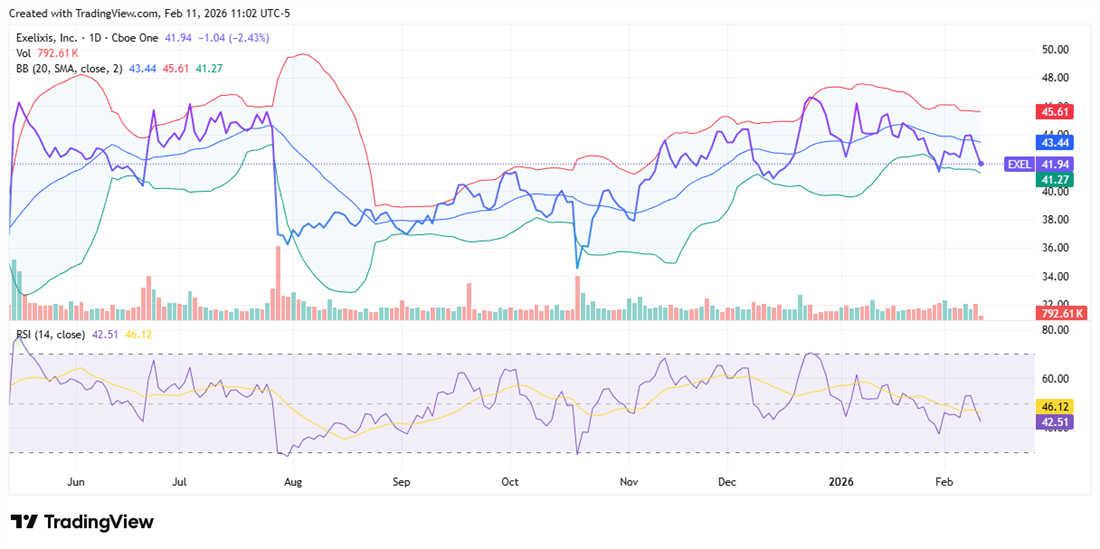
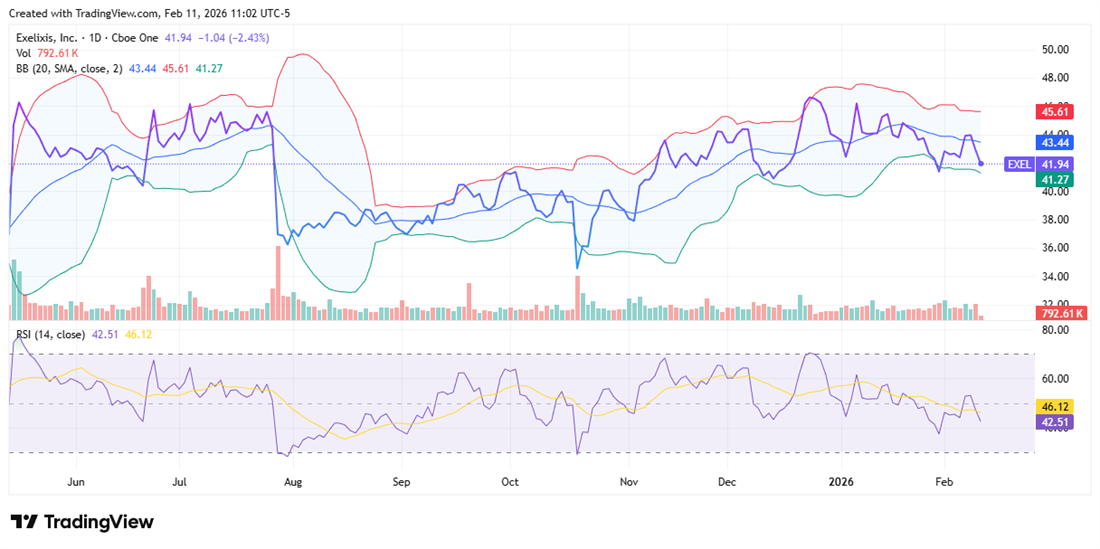
The EXEL chart looks constructive: the stock sits just below the 50-day simple moving average (SMA), which has recently acted as support. Momentum indicators were neutral heading into earnings, and the stock traded roughly 8.6% below the consensus price target of $46.12.
Analyst action after earnings was mixed but not bearish. Wells Fargo reiterated an Equal Weight rating and raised its price target to $35 from $30. Barclays earlier raised its target to $44 from $41 on Feb. 4.
For now EXEL is in a consolidation pattern, but if the company's growth plans unfold as expected, all-time highs could be achievable within the next 12 months.
 Exelixis Is at an Inflection Point
This story is about more than beating quarterly expectations. Exelixis is transitioning from a single-product company to a multi-franchise oncology player, and 2026 is shaping up as the year that transition becomes tangible.
The FDA decision on zanzalintinib in colorectal cancer (Prescription Drug User Fee Act (PDUFA) date: Dec. 3, 2026) represents the company's first major expansion beyond cabozantinib. If approved, zanzalintinib could unlock the company's cited $5 billion peak sales opportunity and validate the franchise strategy.
A key signal to watch is R&D spending. Despite improved profitability, Exelixis plans to maintain roughly $1 billion in annual R&D investment while continuing share buybacks. That suggests management is balancing investor returns with aggressive development—supporting seven pivotal trials for zanzalintinib alone, plus four early-stage programs advancing toward later-stage development.
For context, the expanded gastrointestinal and neuroendocrine sales teams are not just chasing near-term growth; they are positioning the company for a potential zanzalintinib launch later this year. The pieces appear to be moving into place for a more sustainable, multi-product growth story anchored in deep tumor expertise rather than single-drug binary outcomes.
This email is a sponsored message provided by Porter & Company, a third-party advertiser of MarketBeat. Why did I get this email content?.
If you need help with your subscription, please email our U.S. based support team at contact@marketbeat.com.
If you would no longer like to receive promotional emails from MarketBeat advertisers, you can unsubscribe or manage your mailing preferences here.
Copyright 2006-2026 MarketBeat Media, LLC. All rights protected.
345 North Reid Place, Sixth Floor, Sioux Falls, S.D. 57103. USA..


No comments:
Post a Comment